Why one dress needs three measurements
A dress is the rare garment that must clear your bust, waist, and hips in a single cut, so its size is decided by the point with the least give. A fitted bodice is controlled by the bust or waist, a sheath by the hip, and a loose shift mostly by the shoulder and the length from shoulder to hem. Before you open any chart, look at where the dress is tailored: darts, a waist seam, a defined bodice, or a straight fall from the shoulders. The controlling measurement is the one that cannot be disguised by fabric or a belt. When your three measurements point to different columns, and they often will, the dress usually has to satisfy the tightest fitted point first, because the others can be adjusted later in most styles.
Placing the tape: bust, waist, and hip landmarks
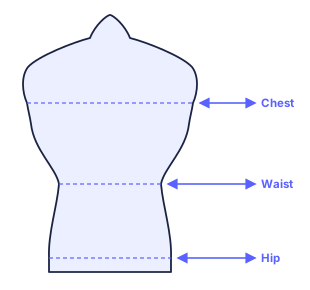
All three measurements need consistent landmarks or the chart comparison breaks down. Take the bust around the fullest part of the chest with the tape level across the back, breathing normally rather than holding a deep breath or letting it all out. Take the waist at the natural crease: bend sideways and mark where the torso folds, usually an inch or two above the navel, which is higher than most waistbands sit. Take the hip at the fullest point around the seat, typically seven to nine inches below the natural waist, with your feet together and the tape passing over the widest curve rather than just the hip bones.
Measure in form-fitting underwear, not over leggings or a padded bra you will not wear with the dress. Write all three numbers down before comparing, because a dress chart grades all three columns together and a single number cannot carry the decision.
Woven structure, stretch fabric, and the room in between
The fabric decides how much forgiveness the chart is allowed. A woven dress in cotton poplin, linen, or structured satin has almost no give, so the pattern itself must supply the ease, the extra room that lets you sit, raise an arm, and breathe after dinner. A stretch jersey or ribbed knit can sit closer to the body and still move, but stretch also reveals strain: a knit pulled tight shows lines and clings where a woven would simply feel firm. Formal dresses often combine both, with a woven shell over a lining that has no stretch at all, so treat them like woven garments even when the outer layer looks soft. For structured or lined pieces, land comfortably inside the size range rather than at its absolute edge, and save the close fit for casual knits that are designed to be worn that way.
Mini, midi, and maxi: length is part of the size
A dress chart covers width, but length changes with your height, and the same labelled size can end at a different point on two different bodies. Most brands draw petite for wearers around 5 feet 3 or 5 feet 4 inches and under, regular for the mid-five-foot range, and tall from around 5 feet 7 or 8 inches up, and the cutoffs are not standardised, so a “regular” in one brand can equal a “tall” in another.
Petite is also more than a shorter hem: the waist seam, bodice length, and shoulder-to-waist distance all move up, which is why a regular dress that is hemmed shorter can still sit wrong at the waist. Before ordering a maxi, check the stated shoulder-to-hem length against your own body length; a maxi drafted for a regular frame can pool on a petite wearer and stop awkwardly above the ankle on a tall one. The size label is only the starting point.
Converting US, UK, EU, AU, and French labels
International dress labels follow rough arithmetic. A UK size is usually the US size plus four, and an EU size is roughly the US size plus thirty, so a US 6 reads UK 10 and around EU 36, but some European brands use a different offset and run a size narrower, while French labels can sit a couple of numbers higher and Italian ones differ again. Australian sizes generally follow the UK numbering. Because the offsets are conventions rather than rules, the reliable cross-border method is the measurement columns themselves: a chart that lists bust, waist, and hip in centimetres tells you more than any translated label. Convert your own three measurements to centimetres once, keep them in your phone, and compare them against each brand’s table directly instead of trusting the arithmetic.
Between sizes: what a tailor can and cannot change
When your measurements split across two sizes, decide by which alterations are realistic. Taking a waist in at the side seams is routine and inexpensive, and shortening a hem is simpler still. Letting a garment out is the opposite: most mass-produced dresses carry little or no spare seam allowance, and the bust, shoulder, and hip areas are expensive to reshape. So the practical rule is to buy the size that clears the bust and hip, the two places hardest to alter, and have the waist taken in if needed. Lined and beaded dresses complicate the arithmetic, because the lining and the outer layer must be adjusted together, so confirm with the alterations person before assuming an easy fix. Fit the least forgiving point and alter the rest.
When the numbers split across columns
Say the tape reads a 36-inch bust, a 29-inch waist, and a 40-inch hip. The bust and waist sit inside the medium column, but the hip starts the large column, and on a sheath or pencil dress the hip decides. Buy the size that clears the hip, plan to take the waist in at the side seams, and the dress will fit; buy down and there is no spare seam allowance to release.
Keep the same three numbers in centimetres as well. European and Australian sites publish their tables in centimetres, and comparing your numbers directly beats translating labels every time. Re-measure before a big purchase, since weight changes and a new bra both move the bust reading.
Body measurements and size labels vary by brand, so confirm the seller’s current chart for the exact dress before buying.