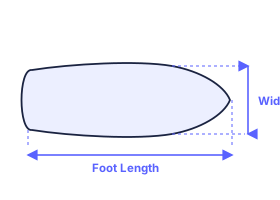
A shoe size is a label assigned to a last, not a measurement of your foot. That is why two pairs with the same US, UK, or EU label can feel different. When you are ordering across regions or brands, use the heel-to-toe measurement in centimetres as the starting point and treat the conversion columns as a helpful translation. Then check the size table published for the exact model, because the last, toe shape, upper material, and intended use can all alter fit.
Measure at home on a hard floor with the socks you expect to wear. Place paper against a wall, stand with your heel lightly touching the wall, mark the tip of your longest toe, and measure that distance. Repeat for the other foot. Use the longer measurement; small left-to-right differences are common. Measure later in the day if possible, because feet often gain volume after walking and standing.
Leave room for movement, not empty space
Shoes need a small amount of space beyond the longest toe so the foot can move during a stride. The required allowance depends on the activity and shape of the shoe. A running or hiking shoe often needs more space than a dress shoe, especially for downhill movement. A pointed toe uses length differently from a round toe. Instead of applying one fixed conversion formula, check whether your toes can lie flat, your heel stays stable, and the upper does not pinch the widest part of your foot.
Try the shoes on both feet and walk on a clean indoor surface. Check fit after a few minutes rather than only while seated. If your heel lifts substantially, first confirm that the length is not too long and that the shoe is laced correctly; moving down a size can solve one problem while creating toe pressure. If the toe box pinches but the length is right, look for a wider width or a model with more forefoot volume rather than simply sizing up.
Converting US, UK, EU, JP, and CM sizes safely
Conversion tables are most dependable within the same chart and audience; they are less dependable when crossing children’s, unisex, or brand-specific systems. A CM/JP label is often a labelled-size field, while Foot Length is a body measurement; shoe interior length is a third measurement that only a manufacturer can confirm for a model. For a unisex model, confirm which scale the seller uses before converting.
Use this decision order:
- Measure your longer foot in centimetres.
- Open the exact model’s official size table and identify its CM or JP column.
- Compare width guidance and the stated fit (narrow, regular, wide, or roomy).
- Convert to a regional label only after you have selected the length range.
- Review the seller’s exchange policy before wearing the pair outside.
Width, volume, socks, and orthotics
Length is only one dimension. A wide forefoot, high instep, orthotic, thick sock, or swelling during long shifts can change the size or width that feels right. Measure around the widest part of your forefoot if a retailer provides width guidance, and test any orthotic in the shoe because it reduces interior volume. For boots and hiking shoes, bring the socks you will actually use. For sandals, check that your heel and toes sit within the footbed rather than hanging over its edges.
Children’s feet should be measured regularly rather than estimated from their last shoe or age. Leave the growth allowance stated by the product guide, but do not buy so much extra length that the child has to grip with their toes. For safety footwear or sport-specific shoes, follow the manufacturer’s fitting advice where it differs from a general chart.
When a size chart cannot settle the question
If your measurement sits between sizes, use the product’s stated fit, your sock thickness, and the return policy to decide. A retailer’s reviews can reveal recurring issues such as a narrow toe box, but they are personal fit experiences rather than a universal rule. Record the model, width, and size when a pair works well. Over time, your own successful pairs become a far better fit reference than a single conversion table.
This guide explains a repeatable measurement process. It does not replace the current size chart supplied with the individual shoe you are buying.
Record a successful fit for future comparison
After a pair has been worn long enough to confirm comfort, note the model, labelled size, width, foot length used, sock thickness, and activity. This turns a one-time purchase into a useful personal reference. It is especially helpful when moving between a casual shoe, a running shoe, a boot, and a sandal, because a successful fit in one does not automatically transfer to another. Keep the exact seller chart with that note when possible.