Why two people who both say “size 7” may need different rings
A ring size is a label for the ring’s inside circumference, the distance around the inside of the band, rather than for a finger. Two national systems can use the same number for different circumferences, and even within one system the same label hides small steps. In the US scale, for example, a size 7 ring measures about 54.4 mm around the inside, which works out to roughly 17.3 mm across the inside diameter; in Japan, a size 7 describes a much smaller ring. The number only becomes useful once you know which scale the seller is using. That is why the safest habit is to work in millimetres: the inside circumference, or the inside diameter, is the physical fact that every national scale translates from. Measure it once, record it, and then read any chart (US, UK, EU, Japanese, or Swiss) against that single value.
Diameter or circumference: two ways to read the same finger
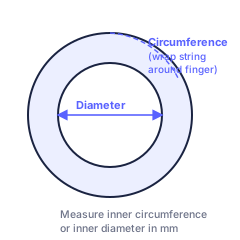
You can arrive at your size from either direction. The most dependable home method is to take a ring that already fits the intended finger well and measure its inside diameter across the widest point with a ruler that reads millimetres. The diameter is easier to measure accurately than the circumference, and the chart converts it for you: a 17.3 mm inside diameter is a US 7, and a millimetre or so of difference generally moves you a full size.
If you have no fitting ring, wrap a thin strip of paper around the base of the finger (dental floss works too, and stretches less than string), mark where the end overlaps, and measure that length flat in millimetres. This is your circumference reading. Divide it by 3.14 and you get the diameter, which lets you cross-check one method against the other. Always measure the specific finger the ring is for: the index, middle, and ring fingers differ, and the dominant hand’s fingers usually run about half a size larger.
Knuckles, band width, and the moment you measure
Two forces pull a ring in opposite directions. The band must pass over the knuckle, which is wider than the base of the finger, but it must then sit securely at the base without sliding off. When the knuckle is noticeably larger than the finger base, which is common, you fit the knuckle and accept that the band may turn at the base, or choose a style that helps, such as an adjustable shank; a jeweller can advise.
A ring that scrapes over the knuckle with real resistance is too small, even if it feels fine once it is on.
Band width changes the fit at the same numerical size. A wide band (roughly 6 mm and above) contacts more skin and feels tighter, so most jewellers suggest going up about half a size for wide styles. Temperature and time of day matter too: fingers are slimmest when cold and first thing in the morning, and swell with heat, exercise, and sometimes salt. Measure when your hands are warm and at a normal time of day, and if the reading sits between sizes, remember that the ring still has to clear the knuckle.
Converting between US, UK, EU, and Japanese scales
Once you have the circumference in millimetres, the international scales fall into place. The ISO 8653 standard behind European sizing is the simplest: the EU size is the inside circumference in millimetres, rounded, so 54.4 mm is an EU 54, and a US 7 is therefore an EU 54. The UK system uses letters from A to Z, with each step worth about 1.25 mm of circumference and half-sizes between letters; a US 7 corresponds to roughly a UK N or N½. Japanese sizing is numeric again but on its own scale, with a US 7 matching a Japanese 14, and French, German, and Swiss systems each carry their own numbers or letters.
Rather than memorising these pairs, keep the millimetre value. Every reputable chart carries a circumference or diameter column, and matching those columns across two charts is always safer than converting a size label through a third system.
When to size up, and when resizing is off the table
If your measurement falls between two printed sizes, lean larger for a ring with stones or a wide band, and consider the smaller only for a slim plain band, since the material and setting take up room. Ordering larger is also the safer error in general: most plain metal rings can be reduced or enlarged by one to two sizes by a jeweller, and it is easier to make a ring smaller than larger.
Resizing is not a universal safety net. Eternity bands with stones set all the way around, heavily engraved rings, and rings made from very hard metals such as tungsten or titanium usually cannot be resized at all. If the ring is a surprise or a final sale, verify the size twice and check the seller’s exchange policy before committing.
Measuring at home, step by step
- Choose the exact finger and hand the ring will be worn on.
- Measure a well-fitting ring’s inside diameter in millimetres if you have one.
- Otherwise wrap paper or floss around the finger base, mark the overlap, and measure flat.
- Measure when hands are warm, and confirm the band clears the knuckle.
- Compare your millimetre value with the seller’s chart, accounting for band width and resizing options.
Ring size scales and band measurements vary by brand, so confirm the seller’s chart for the exact ring before buying.