Practical measurement and conversion reference

Bra Size Chart, US, UK, EU & AU Cup Sizes

Finding the right bra size can be confusing when every country uses a different system. This chart converts US bra sizes to UK, EU (France/Spain), AU/NZ, and Italian sizing, covering band sizes 28–46 and cup sizes AA through G.

Standard reference

Bra Size Chart

Band, bust difference, and cup reference

General use Check merchant guide
Band (in)Band (cm)Bust Diff (in)CupSister Size UpSister Size Down
30761A32AA—
32811A34AA30B
32812B34A30C
34862B36A32C
34863C36B32D
36913C38B34D
36914D38C34DD
38964D40C36DD
38965DD40D36DDD
401015DD42D38DDD
How to measure

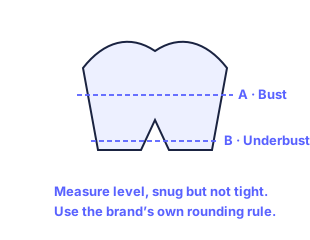
Measure the band snugly under the bust. Measure the bust loosely around the fullest point. The difference determines the cup.

Fit note

Bra sizing varies heavily by brand, fabric stretch, and style. Sister sizing can help find a better fit.

This chart is a simplified reference. Always check the brand's official bra fit guidance.

Decision workflow

Use this chart to make a size decision

Start with a measurement, not the size printed in an older item. The steps below turn a chart row into a checkable purchase decision.

  1. 1
    Measure the right point

    Record a snug underbust and a relaxed fullest-bust measurement using the same unit. Wear a non-padded bra if possible.

  2. 2
    Choose the controlling measurement

    Use the underbust figure to find the band reference, then use the bust difference for the cup reference. Keep country systems separate rather than assuming a cup letter is universal.

  3. 3
    Verify against the listing

    Assess band support, cup containment and strap adjustment together. If only one area is wrong, use sister-size logic rather than changing both band and cup at random.

How to Measure

Follow these steps before buying online to get the most accurate size. Measure twice, order once.

  1. You'll need a soft fabric tape measure, the kind used for sewing. A rigid ruler or metal tape won't conform to your curves and will give an inaccurate result. If you don't have one, a piece of string plus a ruler works too.

  2. Measure your band size first: wrap the tape firmly around your ribcage directly under your bust, where the bra band sits. Keep it snug, you should be able to slide only one finger underneath. The number you get is your raw band measurement. If it's an odd number, round up to the next even number (e.g., 33 inches → 34 band).

  3. Measure your bust size next: wrap the tape around the fullest part of your chest, keeping it parallel to the floor across your back. Don't push the tape into your skin or pull it tight, let it rest comfortably. Don't lean forward. This is your overbust (bust) measurement.

  4. Subtract your band measurement from your bust measurement to calculate your cup size. The difference in inches = your cup: 0 in = AA, 1 in = A, 2 in = B, 3 in = C, 4 in = D, 5 in = DD/E, 6 in = DDD/F. For example: band 34, bust 37 → difference 3 → cup C → size 34C.

  5. If the size you calculate doesn't feel right, try sister sizing: every cup has an equivalent across band sizes. A 34C, 36B, and 32D all contain the same cup volume, only the band length changes. If the band is too tight, go up one band size and down one cup size.

  6. Common mistakes: measuring over a padded bra (adds 1–2 inches to bust), measuring on a single exhale or inhale (take a normal breath), measuring while leaning forward (makes bust look larger). Measure standing upright, wearing only a thin bralette or no bra.

How to measure for bra size chart, us, uk, eu & au cup sizes — measurement diagram
💡

Measurements vary by brand. Always check the brand's specific size chart before purchasing — or use the free generator below to build a custom chart for your store.

Start with the band: two numbers, not one

A bra size is a pair, band and cup, and the band is the part that does most of the work. Fitting guidance commonly teaches that roughly 80 percent of a bra’s support comes from the band rather than the straps, which means the band must be snug enough to stay level and carry the load on its own. The classic mistake is reaching for a larger band when the real problem is a cup that is too small: a small cup borrows space by pushing the band away from the body, and that pressure feels exactly like a tight band.

The size is calculated from two measurements with a fixed relationship between them. The underbust sets the band, and the difference between the fullest bust and the band sets the cup letter. When a bra feels wrong, re-examine both numbers rather than one of them.

Measuring underbust and bust

Use a soft tape. For the underbust, stand relaxed and wrap the tape directly under the bust, parallel to the floor, firm enough that you can slide one finger underneath. In the traditional method, an odd result rounds up to the next even number for US and UK labels (a 33-inch underbust starts at a 34 band), but be ready to try the neighbouring band as well, since bodies and brands do not read perfectly round numbers.

For the bust, wrap the tape around the fullest part, usually across the nipple line, keeping it level across the back and resting without compressing. Stand upright rather than leaning forward, and measure over a thin layer or bare skin, avoiding a padded bra, which can add an inch or more to the result.

The difference in inches between the two measurements maps to cup letters: one inch for A, two for B, three for C, four for D, five for DD or E, and six for DDD or F, continuing upward. That arithmetic produces a starting size, not a verdict; the try-on decides.

Cup letters mean different things in US, UK, and EU charts

Band systems diverge too. US and UK bands share the same numbers, but European bands are labelled by underbust in centimetres rounded to a five: a US/UK 32 is an EU 70, a 34 is an EU 75, and a 36 is an EU 80. The cup alphabets diverge after D. UK cups progress A, B, C, D, DD, E, F, FF, G, GG, while many US brands go from DD and DDD straight to G, H, and I, skipping the E and F letters. A UK FF is therefore a US H, and a UK 34FF is a US 34H and roughly an EU 75H.

The practical warning: reading a UK brand’s chart with US habits makes every cup above DD wrong, and reading an EU chart requires converting the band first. Check which alphabet the brand uses before comparing cups across countries.

Sister sizes and when to use them

Cup volume is relative to the band. A 34C, a 32D, and a 36B all hold the same cup volume on different bands. Moving between these sister sizes (up a band and down a cup, or down a band and up a cup) preserves volume while changing the band length and usually the wire width.

Sister sizing solves specific problems, not every problem. If the band is right and the cup gapes or overflows, change the cup instead of the band. If the band feels tight while the cup looks correct, first check that the straps are not over-tightened and the cups are not too small, both fake band tightness, then try the next band with the sister cup. Do not sister-size more than one step away: beyond that, the wire width and placement drift far enough that the fit degrades.

Fit checks: band, wires, and straps

Fasten a new bra on the loosest set of hooks, leaving the tighter hooks for later as the band relaxes with wear. Then run through the checks. The band should sit horizontally around the torso and stay put when you raise both arms; if it rides up the back, it is too large. In a wired bra, the centre gore (the bridge between the cups) should lie flat against the chest; a gore that floats usually means the cups are too small or the wires are the wrong shape. The underwire should encircle the breast tissue without sitting on it, and after scooping tissue forward into the cups from the sides, the top edge of each cup should lie smooth, with no gaping and no overflow.

Sports bras and other styles that bend the rules

Sports bras often abandon the band-and-cup arithmetic for letter sizing or a simplified range, because their support strategy is different. Compression styles hold by pressing the tissue against the chest, while encapsulation styles use shaped cups around it. A compression style in a letter size trades cup precision for motion control, and its fit test is also different: jump, jog in place, and raise the arms, the band must not shift and the bust must not bounce painfully. For larger cup sizes, an encapsulation or combination style is generally the more supportive route.

Bralettes, wire-free styles, and minimiser bras also read differently from a wired bra in the same size, so follow the retailer’s style-specific instructions rather than the general chart.

Band and cup labelling varies by brand and country, and styles fit differently; confirm the seller’s current chart for the exact bra before buying.

Frequently Asked Questions

Common questions about bra size chart, us, uk, eu & au cup sizes answered by our sizing experts.

What is the difference between US and UK bra sizes?

US and UK bra band sizes are the same number but cup sizes differ from DD onward. In the UK, after D comes DD, E, F, FF, G. In the US, after D comes DD/E, DDD/F, DDDD/G. Always check both cup and band when converting.

How do I convert my bra size to European sizing?

EU bra band sizes are calculated differently from US/UK. Add 15 to your US band size to get the approximate EU band size. For example, a US 34 band ≈ EU 75. Cup letters A through D are generally the same across US, UK, and EU.

What if a bra fits in the band but the cups are wrong?

Try sister sizing: go down one band size and up one cup size (or vice versa) to get an equivalent fit. For example, 34C and 36B have the same cup volume.

How do I know if my bra band fits correctly?

The band should sit horizontally around your torso and feel snug, you should be able to fit two fingers underneath. If the band rides up your back, it's too loose. Most of the support (about 80%) should come from the band, not the straps.

What does 'DD' mean in bra sizing?

DD means 'double D' and represents a cup that is approximately 4–5 inches larger than the band. In US sizing, DD is one step above D. In UK/AU sizing, DD is also used, followed by E, F, FF, G for larger cups.