Mondopoint is a length, not a guess
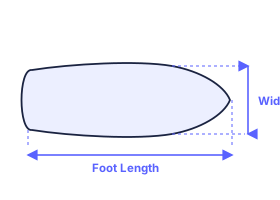
Ski boots are sized in Mondopoint, which is simply foot length in centimetres: a boot marked 26.5 is built for a foot roughly 26.5 cm long. That directness is the system’s value, because it removes the regional translation that makes street shoe sizes unreliable: a US 9, a UK 8.5, and an EU 42.5 are all descriptions of roughly the same foot length, while the Mondopoint number is the length itself. Every ski boot brand uses the same scale, so your measured foot travels across brands without conversion. Measure both feet while standing on a hard floor, heel against a wall, wearing the socks you will ski in, and record the heel-to-longest-toe length for each. Use the longer foot. One Mondopoint step equals one centimetre, which is why half sizes in ski boots exist: they are genuinely half-centimetre increments in the label, even though many brands build whole and half sizes on the same plastic shell and differ only in the liner or footbed.
The shell fit test: reading the space behind your heel
Because liners vary, the size label cannot tell you the whole story; the shell can. The shell fit test is how bootfitters verify length: remove the liner, stand your foot in the bare plastic shell with toes just touching the front, and look at the gap behind your heel.
For most recreational skiers the target is about 15 to 20 millimetres (roughly two stacked fingers), which keeps the foot anchored when the boot is flexed. Expert and racing skiers accept tighter shells, around 8 to 15 millimetres, for quicker response, while three fingers or more of space means the shell is a size too big.
The test matters because the liner hides errors. A thick liner in a large shell can feel snug in the shop and sloppy on snow once the liner packs out, and two boots with the same Mondopoint label can have different shell interiors. If you cannot perform the test yourself, ask the shop to show you the shell fit before buying.
Flex, last width, and other numbers on the box
Two more numbers describe how the boot behaves. The flex index, commonly from about 60 to 130, rates forward stiffness: softer boots in the 60 to 80 range suit lighter and less experienced skiers who need to bend the boot with less force, while stiffer boots around 110 to 130 reward strong, aggressive skiing and punish beginners with harshness. Flex ratings are not standardised across brands, so treat them as relative within a brand.
The last is the boot’s width across the forefoot in millimetres, quoted for a reference size. Narrow lasts of roughly 96 to 99 mm serve low-volume and racing feet; a standard last around 100 to 102 mm fits most skiers; wide lasts of about 102 to 106 mm accommodate broad or high-volume feet. The last number alone does not describe the heel pocket, instep height, or cuff shape, and sizing up in length to gain width is a poor trade, because it adds volume everywhere, including where you need hold.
Ski socks are part of the fit, not an afterthought. Wear one pair of thin, smooth ski socks, never thick hiking socks or doubled socks, which add bulk unevenly and undo the shell fit you just verified. Measure and try boots in exactly the socks you will ski in. A supportive footbed can also change the effective size and volume, stabilising the foot and preventing it from spreading inside the shell; if you use orthotics, bring them to the fitting.
Liners compress with use, which is why a new boot should feel snug rather than comfortable. A boot that feels perfect on day one is usually loose by day five. The in-shop test is the toe check: standing upright, your toes should just graze the front of the liner; when you flex your knees forward into a skiing stance, they should pull back slightly and the heel should stay planted with no lift. Buckles should close near the middle of their ladders; if they max out on day one, the boot has too much volume.
Who should downsize, and who shouldn’t
Sizing down below your measured Mondopoint is a performance choice, not a rule. Advanced and expert skiers sometimes take a shell a step shorter than their foot length for precision, accepting a much tighter heel gap in the 8 to 15 millimetre range.
Most recreational skiers should match their measured length with the standard 15 to 20 millimetre shell gap: the boot still grips far more than a street shoe, and the difference in control does not justify numbness or pain. If a boot causes tingling, sharp pressure, or loss of feeling, it is too tight no matter what the label suggests.
Resist the opposite error too. A boot that feels spacious and pleasant in a warm shop is usually too large once cold plastic stiffens on the mountain. Shells can be stretched wider by a fitter (punched or ground at pressure points) but they cannot be made smaller, so the safer error when a length is genuinely borderline is the tighter option you can still tolerate.
What to check at the shop, in order
- Measure both standing feet in centimetres in thin ski socks; use the longer foot.
- Select a boot near your Mondopoint length and check the shell fit with the liner removed.
- Confirm the last width and instep volume suit your foot shape.
- Match the flex to your weight, experience, and skiing style.
- Wear the boots in the shop for fifteen minutes or more, buckled and flexing forward, before deciding.
Ski boot shells, flex ratings, and size labels vary by brand, so confirm the seller’s or fitter’s chart for the exact boot before buying.