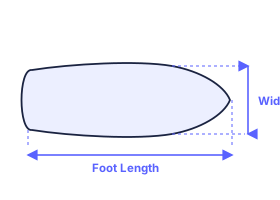
Every conversion table is a translation between label systems, and labels describe lasts, not feet. Two brands’ size 10s are built on different foot shapes, so the most dependable cross-brand reference is the length of your own longer foot in centimetres, matched against the brand’s CM or JP column. Measure both feet standing on a hard floor, in the socks you plan to wear, and record the longer result. Feet are rarely equal (a few millimetres of difference is normal), and sizing to the shorter foot guarantees pressure on the longer one. Measure in the afternoon or evening, when feet have settled to their largest, and add the allowance the shoe type needs, roughly 0.5 to 1 cm beyond foot length for most styles. Only then read the regional label that corresponds to that length in the brand’s table.
Reading US, UK, EU, and JP labels side by side
The four common labels do not share a step size. US and UK sizing moves in barleycorn increments, about a third of an inch between whole sizes, while EU sizing steps in Paris points of about 6.7 mm, which is why EU half steps appear irregular next to US sizes. JP labels state foot length in centimetres, which makes them the most transparent of the four.
As a general map for adult men, the EU label runs about 33 above the US label (US 9 ≈ EU 42, US 10 ≈ EU 43), and the UK label runs about half to one size below it, so a US 10 is roughly a UK 9 or 9.5. The same US 10 sits near a 28 cm JP label. These rules drift at the extremes of the scale and between brands: a US 10 that is EU 43 in one brand and EU 44 in another is common, not an error. Use the rules to orient yourself, then confirm the exact model’s table.
Width letters are a second size you may be ignoring
US men’s shoes carry width letters that matter as much as length for many feet. D is the standard medium width, B and C are progressively narrower, and E, 2E, and 3E are progressively wider, with some athletic brands running to 4E and beyond. A foot that measures 28 cm but is broad will still be unhappy in a D width; the fix is the same length in 2E or a model with a roomier forefoot, not a longer shoe.
Length compensates poorly for width. Sizing up to gain toe room adds heel slip and moves the shoe’s flex point away from the ball of the foot, which can make walking feel clumsy even when the toes finally fit. If your shoes have always pressed across the widest part of the foot despite a “correct” length, measure across the forefoot and look for brands that publish width or last-volume guidance.
Why half sizes matter
In US sizing a half size is about 4.2 mm, a sixth of an inch, of extra length. It is a small distance that changes fit noticeably, because the foot’s flex point must align with the shoe’s. Being between sizes is a normal state, not a measuring error. When your measurement falls between sizes, decide with the product’s stated fit: a model said to run short gets the upper half size, a roomy last gets the lower one, and thick socks or an orthotic push you up. Buy length for the longer foot and volume for the wider one, and remember that toe-box shape (pointed, rounded, or squared) changes how the same length is consumed.
Athletic lasts and dress lasts are not the same
A running shoe, a leather Oxford, a hiking boot, and a loafer can share a size label while fitting nothing alike, because the last, the form the shoe is built around, differs by purpose. Athletic lasts often carry more volume in the forefoot to allow toe spread during stride. Dress lasts are frequently slimmer and lower in volume, with a pointed or almond toe that asks more of the forefoot. Hiking boots are usually sized with thicker socks and downhill movement in mind, which is why many hikers take a half size up from their dress-shoe size. Transferring “your size” from one category to another without checking the model’s chart is the most common way an online shoe order goes wrong.
Before an order, the sequence matters: measure both feet in the socks you will wear, note the longer centimetre value, find the model’s CM or JP column, and pick the length range, then read the width guidance and the stated fit. Skipping the width check is the most common unforced error, since a D width and a 2E in the same length are different shoes.
When the shoes arrive, the try-on has its own order. Lace them properly, stand and walk on a clean indoor surface, and judge after several minutes: the toes should lie flat, the heel should stay put through a step, and the flex point should meet the ball of the foot. If the heel slips, the width letter or the last is usually the cause, not the length.
Record the model, size, and width that worked; that note becomes your best reference for the next pair, since two brands’ charts rarely agree with each other. Foot measurements, width scales, and lasts vary by brand and model, so confirm the seller’s current chart for the exact shoe before buying.