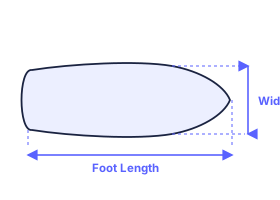
New Balance is one of the few major brands that offers wide (2E) and extra-wide (4E) sizing across most models. This makes their size chart especially important, not just for length, but for width too.
Use the official chart for this purchase
Measure the relevant body part or longer foot, select the official table for the exact product and audience, then compare the measurement with the column named by that table. Do not treat this independent guide as a complete brand chart.
Fit Notes for New Balance Size Chart
Brand-specific sizing advice that goes beyond the standard chart.
1
New Balance D width is standard for men, B width for women. If you have wide feet, look for 2E (men) or D (women) width options.
2
The 990 and 993 series run true to size with a roomy toe box. The 574 and 327 lifestyle models also run true to size.
3
New Balance Fresh Foam and Fuel Cell running shoes can feel slightly narrow, consider going half a size up or selecting a wider width.
4
The 990v6 in particular is widely reported to run long, many wearers order half a size down, while earlier 990 versions are more often described as true to size.
Treat length and width as two separate decisions
New Balance is built around the idea that a shoe size is a length plus a width, and the width part is where this brand differs from almost everyone else. Begin with length: stand on a hard floor in your intended socks, measure both feet heel-to-toe in centimetres late in the day, and match the longer foot to the model’s chart. Then measure width across the widest point of the foot, usually the ball, and compare it with the width options offered for the exact model, because New Balance sells the same length in several widths, and the step between a D and a 2E is often larger in practical terms than the step between adjacent lengths.
New Balance’s width guidance makes two practical points worth taking seriously: the shoes should fit comfortably out of the box rather than through a break-in period, and feet tend to widen with age, so re-measure periodically even if your shoe size has been stable for years. If you wear an orthotic or insert, measure and try on with it in place, since it changes both the volume and the effective length of the shoe.
Decoding the width letters
The same letter means different things on the men’s and women’s scales, so always confirm which chart a model is using. For men, B is narrow, D is standard, 2E is wide, 4E is extra wide, and 6E appears on select styles. For women, 2A is narrow, B is standard, D is wide, and 2E is extra wide. A women’s D is therefore a wide shoe while a men’s D is the default, and a men’s B is narrow while a women’s B is the standard. Each step across the ladder adds only a few millimetres of total width, which is still usually the difference between a comfortable day and cramped toes.
Between two widths, prefer the wider width over the longer size. Adding length pushes the flex point and the toe room out of position and does nothing for the heel; a wider width adds room where the foot actually needs it, across the ball and toe box. If the wider option leaves the heel sloppy, you probably need a different model or last rather than a different letter.
How the running lines fit
New Balance’s running range shows how width interacts with model design. The Fresh Foam X 1080 is the most popular cushioned trainer and fits true to size for most wearers; retailer surveys put true-to-size agreement near eight in ten. The v13 gets consistent reports of a narrower toe box, and the standing advice is a half size up or a wide width for wide feet. Across the Fresh Foam and FuelCell lines the pattern in width guides is the same: the performance lasts run slightly narrower than the lifestyle lasts, and a half size up or a wider width is the usual fix. The 880 and 1080 running models sit at the narrower end of that comparison, which matters if you are moving from a lifestyle pair into running shoes: do not transfer your 574 size to a 1080 without checking the width column first.
For race-day or track models, expect a deliberately close fit and read the model’s own sizing note, since performance shoes trade toe room for lockdown. If you run long distances, try the shoes late in the day and in your race socks. A fit that feels roomy at a morning fitting can tighten noticeably after an hour of running.
The lifestyle classics and their quirks
The 574 is the baseline: most wearers find it true to size with a roomy toe box, though unisex releases are built on the men’s scale, so a woman ordering a unisex 574 usually needs to go down about 1.5 sizes from her women’s size. The 327 is the temperamental one: roughly seven in ten wearers report a true-to-size fit, but a significant minority describes a narrow midfoot and toe box, and heel slip appears in reviews from both camps. If your foot is wide or high-volume, try the pair on or lean half a size up. The Made-in-USA 990 series deserves its own note: the current 990v6 runs long in most wearers’ experience, and many order half a size down from their usual size, while earlier 990 versions are more often described as true to size with a roomy toe box. Check which version you are buying before you trust a 990 reputation built on an older release.
Unisex scales and regional labels
New Balance sells many models in unisex sizing built on the men’s scale: a unisex 9 is a men’s 9 and a women’s 10.5, and the width letters follow the men’s ladder too, so a D on a unisex pair is the men’s standard rather than the women’s wide. When a listing shows both men’s and women’s sizes for the same model, treat them as two different fits, not the same shoe with two labels.
Regional labelling adds one more wrinkle: in markets such as Japan, New Balance’s standard width presentation differs, with D described as slightly narrow and 2E as the standard for many models. An imported pair’s width letter can therefore mean something different from what you expect in a US store. If you are buying an imported or region-specific release, read the seller’s width explanation instead of assuming the letter carries its US meaning.
The New Balance pass
Measure the length and width of both feet while standing, late in the day, with your usual insoles or orthotics. Identify which chart the model uses (men’s, women’s, or unisex) and read the width letter on that chart, then choose the width that clears your ball measurement before you adjust the length. Check the model’s own fit reputation too: the 574 runs true, the 327 splits reports, and the 990v6 is generally considered long. Between two options, prefer a wider width over a longer size. Finally, try both feet indoors, walk and turn, and confirm heel hold in the width you chose.
This is an independent educational guide and is not affiliated with New Balance. Product measurements and fit notes can change, so confirm the current New Balance chart and the retailer’s return policy before ordering.
Frequently Asked Questions
Common sizing questions about New Balance Size Chart answered.
Does New Balance run true to size?
Yes, New Balance shoes generally run true to size in length. However, width is an important variable. Standard D (men) and B (women) widths suit most people, but New Balance offers 2E and 4E wide sizing which runs noticeably roomier in the forefoot. If you have wide feet, selecting the right width is more important than adjusting the length.
How do New Balance width sizes work?
New Balance shoes come in multiple widths. For men, standard is D, wide is 2E, and extra wide is 4E. For women, standard is B, wide is D, and extra wide is 2E. If you have never worn wide shoes, measure the width of your foot at its widest point and compare to their width chart.
What is New Balance size 10 in EU?
New Balance US Men's 10 = EU 44. Women's US 10 = EU 41.5. New Balance follows standard US-to-EU shoe conversion with their sizes landing consistent with other US athletic brands.
Are New Balance shoes good for wide feet?
Yes. New Balance is well-regarded for wide foot options. Many of their most popular running and lifestyle styles (990, 574, 860) are available in 2E and 4E widths. This makes them one of the best choices for wide-footed shoppers who have trouble finding comfortable shoes from other brands.
Is this an official New Balance size chart?
No. This is an independent size reference guide produced by SizeChartBase and is not affiliated with, endorsed by, or officially associated with New Balance. New Balance is a registered trademark of its respective owner. Always refer to New Balance's official website for the most current sizing information.
Where does the New Balance size data come from?
This independent guide links to New Balance's official sizing source and explains how to read it. It does not reproduce a complete New Balance chart; verify the current product listing before purchasing.
Standard Size Charts
Generic reference charts for this product category — useful when shopping across different brands.
Disclaimer: This page is an independent size reference guide produced by SizeChartBase and is not affiliated with, endorsed by, or officially associated with New Balance. All brand names, logos, and trademarks are the property of their respective owners. Size data is compiled from publicly available sources including brand websites and product pages, and is provided for informational purposes only. Always verify sizing with the brand's official website before purchasing.