
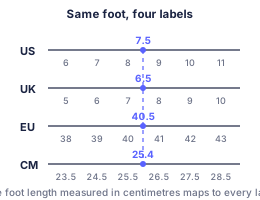
International shoe sizes are labels, not a universal measurement system. A conversion chart can help you recognise that a familiar US, UK, EU, or JP/CM label is in the expected neighbourhood. It cannot prove that two shoes have the same inside length, width, toe shape, or volume.
Photo: a2050, CC BY-SA 2.0, via Flickr.
Start with foot length
Measure both feet while standing and use the longer result in millimetres. When an exact product chart offers a CM or JP foot-length column, compare that number first. Only then translate to the regional label used by the store. This order avoids a common mistake: selecting an EU number from memory before checking what that brand means by it.
Check the scale and the audience
Men’s, women’s, children’s, and unisex scales may not align even when the printed number looks familiar. A UK label is not automatically one fixed step away from a US label across every category. Regional storefronts can also present size ranges differently. Read the heading of the exact chart and confirm whose sizing system it uses.
Treat conversion as a cross-check
If your measured foot length and the product’s CM range agree but the converted EU label feels unfamiliar, trust the measured range and investigate the chart labels. If the numbers disagree, stop and check whether the listing uses insole length, recommended foot length, or a different audience scale.
Use the shoe size chart to understand the columns, and follow the at-home foot method before ordering. A conversion chart is useful vocabulary; a model-specific measurement chart is the purchase decision.
A conversion example without false precision
Suppose a shopper usually buys an EU-labelled casual shoe and is considering a product listed in US sizing. Their first task is to measure the longer foot in millimetres, not to search for an equation between the two labels. If the exact product page gives a foot-length range in CM, they should select that range first. The US and EU columns can then be used as a check that the storefront is showing the intended equivalent.
If the labels do not look familiar, investigate what each column means. A chart may list recommended foot length, insole length, or a brand’s own size scale. An insole is normally longer than the foot it is meant to accommodate, so treating an insole number as a body recommendation can create an unnecessary size change. Likewise, a unisex product may use a different label convention from a women’s or children’s chart.
Use a conversion table in the right order
- Measure both feet while standing and record the longer result in millimetres.
- Open the chart for the exact model and storefront region.
- Select the stated foot-length or CM range when it exists.
- Check width, toe shape, socks, and intended activity.
- Use US, UK, or EU labels only to confirm the chosen row.
This sequence is especially useful when buying internationally. It stops a shopper from assuming that an EU number has one permanent US or UK equivalent across every manufacturer. It also makes a return easier to diagnose: you can compare the measured foot length, the product’s table, and the selected label rather than relying on memory.
When a chart does not show CM
If a product gives only regional labels, find its official size guide or contact the retailer before treating a generic conversion as a guarantee. The current adidas shoe chart, Nike footwear fit guide, and New Balance size and width guide illustrate the type of first-party guidance to seek. They apply to their own products, not to every shoe on the market.
For more context on fit after length is selected, read why shoe width matters. A good conversion chart helps a shopper understand labels; it never replaces a measured foot and the exact product information.
Common conversion traps
Do not assume a size written on an older pair is a permanent conversion key. The shoe may have stretched, the label may use a different audience scale, and a similarly named model may have moved to a different last. A marketplace listing can add another source of confusion by showing an EU label in the title but a US selector in the purchasing control. Check the selected row before placing the order.
Write down the evidence behind an uncertain purchase: longer-foot measurement, exact model, storefront region, chosen CM range, and the label displayed at checkout. This is more useful than saving a generic conversion image. If the pair arrives unexpectedly tight or loose, the record shows whether the issue came from the conversion, the product chart, or the model’s width and shape. For a higher-cost or hard-to-return order, confirm the measurement basis with the retailer in writing before buying.
A worked measurement record
Assume the longer foot measures 262 mm at the end of the day. A shopper should first look for an official product row that explicitly accommodates that foot-length range. If the chart lists 26.0–26.5 cm as a recommended foot measurement, use the row that contains 26.2 cm, then read the US, UK and EU labels shown on that same row. Do not begin with an approximate EU conversion and force the foot measurement to agree afterwards.
Now add the context a conversion table cannot see: the shoe is a narrow court model, the shopper uses thick socks, and the purchase is for long sessions rather than a brief try-on. Those facts may justify comparing the adjacent row or asking the retailer about width, but they do not turn a generic conversion into a guarantee. Keeping length, width and intended use separate is the practical way to reduce false confidence from an otherwise correct conversion.