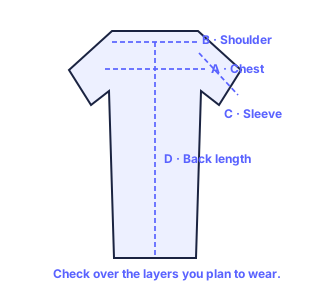
Build your measurement from the layers, not the bare body
Outerwear is the one category where the correct measurement is taken over clothing. A jacket has to close over whatever you will actually wear beneath it, so put on the thickest realistic combination (the sweater, hoodie, or base layer you expect in the coldest use) before the tape comes out.
A chest measured bare produces a jacket that fits over nothing, and every layer added later is stolen room at the shoulders and armholes. Measure the chest over the layers at the fullest point, under the arms, with the tape level across the back, and use that layered number against the chart’s chest column. If the jacket will only ever sit over a shirt, measure that way instead; the measurement should describe the outfit, not the body alone.
Chest, shoulder, and sleeve: the three that decide a jacket
Three anchor points settle most jacket fits. The chest decides the size. The shoulder decides whether the jacket is the right shape: the seam should end exactly where the shoulder meets the arm, neither sliding onto the upper arm nor climbing the shoulder cap, and shoulder width is the most difficult alteration a tailor can attempt on a coat. The sleeve is measured from the centre back of the neck, over the shoulder, and down to the wrist bone with the arm slightly bent, and should end around the wrist without swallowing the hand.
Compare all three against a coat you already own, because a jacket that clears the chest can still fail at the shoulder, and a shoulder that is wrong cannot be fixed cheaply after the fact. Raise both arms with the coat closed: if the whole body of the jacket lifts with them, the shoulder is too snug for its purpose.
Insulated and shell jackets want different allowances
How much spare room a jacket needs depends on what is inside it. A puffy insulated piece already contains its own volume and needs enough garment chest to close over layers without compressing the fill, so its garment measurement commonly runs several inches larger than your body chest, often four to six. A trim shell or a tailored coat over a single layer needs far less, sometimes only a couple of inches. The confusion comes from charts that mix the two languages: some list the body measurements a size is meant to fit, others list the garment’s own measurements. Work out which language the chart speaks before comparing, and treat “to fit” numbers and garment numbers as different currencies.
Converting US, UK, and EU jacket labels
Jacket labels translate across regions with a few dependable offsets. Men’s sizes in the US are chest inches, so a 40 fits a roughly 40-inch chest, and the EU label is usually ten numbers higher, so a US 40 reads EU 50, with sizes stepping in two-inch increments. Letter sizes map roughly the same way: a men’s medium typically sits around a 40 chest, though brands shift the edges.
Women’s jacket labels follow the clothing pattern instead: a US 8 is usually a UK 12 and roughly an EU 38, with European brands varying by a size or two. UK men’s sizing generally matches the US numbers. As with every category, the offsets are conventions; trust the brand’s own chart and your layered chest measurement over the arithmetic. Buying a men’s or unisex style for a woman’s frame adds one more step: expect to size down from the men’s scale and to lose the women’s shaping through the waist and shoulder.
Length, hem, and the cut that matches your use
A jacket’s cut does as much work as its size. A parka reaches past the hip and must clear your seated hip width at the hem, which means checking the hem or hip measurement even when the chest is generous. A bomber or cropped style stops at the waist and is sized mostly by chest and shoulder, while a blazer-like coat adds a structured shoulder and a tapered waist to the same numbers. Length also changes with height: tall ranges add sleeve and body length, petite ranges shorten both, and a coat that ends at the right point in the mirror may still ride up when you sit in a car. Compare the stated garment length against a coat you own, and check the hem width against your seated hip rather than your standing body.
A jacket proves itself in motion. With the piece on over the intended layers, zip or button it fully, raise both arms, reach forward as if holding a steering wheel, sit down, and hug yourself: the positions where shoulders, back, and sleeves complain. If the back pulls tight across the shoulder blades, the cuffs retreat past the wrist, or the chest binds on a full breath, the next size or a different cut is the answer. Check that the sleeves still cover a long-sleeve base layer, and walk around long enough for the insulation to settle. A coat that passes while standing still but fails while driving is still the wrong coat.
The order of checks for a layered jacket
- Measure the chest over your thickest intended layers, in inches and centimetres.
- Check the chart’s language: body measurements or garment measurements.
- Confirm shoulder width and sleeve length against a coat you own.
- Allow the right extra room for insulated versus shell construction.
- Sit, reach, and close the jacket before removing the tags.
Measurements and label conversions vary by brand, so confirm the seller’s current chart for the exact jacket before buying.