Two sizing languages share the same shirts rack
Men’s shirts are sold in two systems that look interchangeable but are not. Dress shirts use body measurements: a neck size in inches or centimetres paired with a sleeve length, such as 15½ 32/33. Casual knits (T-shirts, polos, and henleys) use alpha labels from S to XXL that summarise a chest range. The alpha label hides the chest number behind it, which is why a Medium from one brand can be cut larger than a Large from another. When a chart gives both systems, the measured numbers are the more dependable choice; when it gives only letters, the chest range behind each letter is what you should read.
The split exists because the two garments are worn differently. A dress shirt is buttoned at the collar and usually tucked, so its fit depends on three dimensions: neck, chest, and sleeve. A knit shirt has no collar to close and a forgiving fabric, so chest and body length carry the decision. Decide which kind of shirt you are buying before you measure, because the measurements that matter are not the same.
Taking the three dress-shirt measurements
For the neck, hold the tape at the base of the neck where the collar will sit and keep one finger inside the tape. The finger is the movement and breathing allowance a collar is designed to include, which is why a comfortable collar size usually lands about half an inch above the raw neck measurement. If you fall between collar sizes, round up to the next half inch.
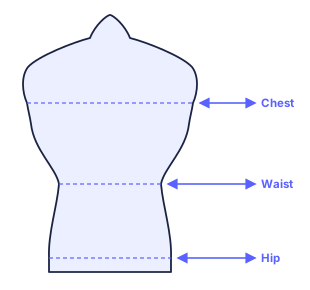
For the chest, stand relaxed with arms down and run the tape under the armpits across the fullest part of the chest and shoulder blades. Keep it level and snug without compressing, breathe normally rather than holding air in, and measure over an undershirt if you wear one under dress shirts.
The sleeve needs a helper: it starts at the centre back of the neck, runs over the shoulder, and ends at the wrist, which is hard to reach accurately alone. Have someone hold the tape at the centre back while it runs over the shoulder and down the slightly bent arm to the wrist bone. Because posture changes the result, sleeve lengths are sold as ranges such as 32/33 rather than single numbers.
Reading a neck-and-sleeve label
A label like 15½ 32/33 states a collar of 15.5 inches and a sleeve falling in the 32-to-33-inch range. Both numbers describe your body plus the shirt’s built-in ease, not the shirt laid flat. If the collar fits and the sleeve feels long, remember that a cuff ending a little past the wrist bone is easier to live with than one that rides up when you bend an arm or drive.
Neck sizes are offered in half-inch steps, and the collar is the one part of a shirt that cannot be quietly adjusted. A collar half a size too small digs in all day and becomes unwearable under a tie; half a size too large opens a visible gap at the back. Fit the collar first, then judge the body through the cut, since many brands attach a roomier body to the same collar in their classic styles.
Collar labels convert through centimetres
The same collar is labelled 15½ in the US and UK but 39 in continental Europe, because European labels state the neck circumference in centimetres. The conversion follows the inch-to-centimetre rule rounded to the nearest label: 15 in ≈ 38 cm, 15.5 ≈ 39, 16 ≈ 41, 16.5 ≈ 42, and 17 ≈ 43. Rounding means the steps do not line up one-to-one, and a 16-inch collar can correspond to either a 40 or 41 cm European label depending on the brand, so treat the conversion as an orientation and confirm the brand’s collar table. Alpha sizes convert even less cleanly: a US Medium can be labelled M, 48, or 50 in different European systems, which is why the chest range behind the letter is the safer comparison.
How alpha sizes and chest ease work
As a general starting map, Small covers roughly a 34–36 inch chest, Medium 38–40, Large 42–44, and XL 46–48, with the neck numbers rising alongside: S ≈ 14–14.5, M ≈ 15–15.5, L ≈ 16–16.5, XL ≈ 17–17.5. These are ranges, not promises, and the chest band behind a letter can shift by a full size between brands. That is why “I always wear a Large” is a weak basis for an online order: read the chest range, compare it with your measured chest plus the ease you want, and only then pick the letter.
Ease is the gap between your body and the garment. A knit with about four inches of ease skims the body; one with eight hangs loosely. In woven shirts, slim cuts leave less room across the chest and waist than classic cuts, and an athletic cut is its own shape: broader through the chest and shoulders, tapered at the waist, built for a larger drop between chest and waist. If your chest exceeds your waist by roughly eight inches or more, an athletic or tapered cut usually fits better than sizing up a classic cut.
Slim, classic, and athletic cuts change which number wins
Cuts do not change your neck or chest size, but they change which measurement decides the purchase. In a classic cut the chest is generous and the collar is the limiting dimension. In a slim cut the chest and waist are the constraints, and a shirt that fits the collar can still pull across the shoulders. In an athletic cut the room exists through the shoulders but the waist is tapered, so a thicker midsection pushes you toward classic.
Test the fitted areas the way you will wear the shirt: button it fully, sit, and reach forward as if driving or typing. Pulling between buttons or across the upper back means the cut is too small, not the collar. Then confirm the collar with one finger inside it and the sleeve with the arm bent.
A 15-inch neck in a slim-fit dress shirt is the classic test case. If the collar buttons comfortably with a finger inside but the chest pulls across the shoulder blades when you sit and reach forward, a 15.5 will not fix anything. The answer is a classic cut in the same collar, or an athletic cut when the shoulders are the wide point. The collar was never the problem.
Brands also re-cut their shirts between collections, so the same letter or number can cover a different chest range a season later. Treat every chart as current to the model you are buying, and confirm the seller’s table for the exact shirt before ordering.