
The most practical size chart reference is often already in your wardrobe. A T-shirt that fits the way you like gives you more useful information than a generic small, medium, or large conversion. It captures your preferred shoulder position, body length, chest ease, and sleeve proportion. The key is to measure it in the same way that the new product page describes its garment.
Choose a reference shirt with the same job as the one you want to buy. Compare a relaxed heavyweight tee with another relaxed tee, not with a fitted athletic top. Fabric weight, stretch, wash treatment, and silhouette all change how a number feels on the body.
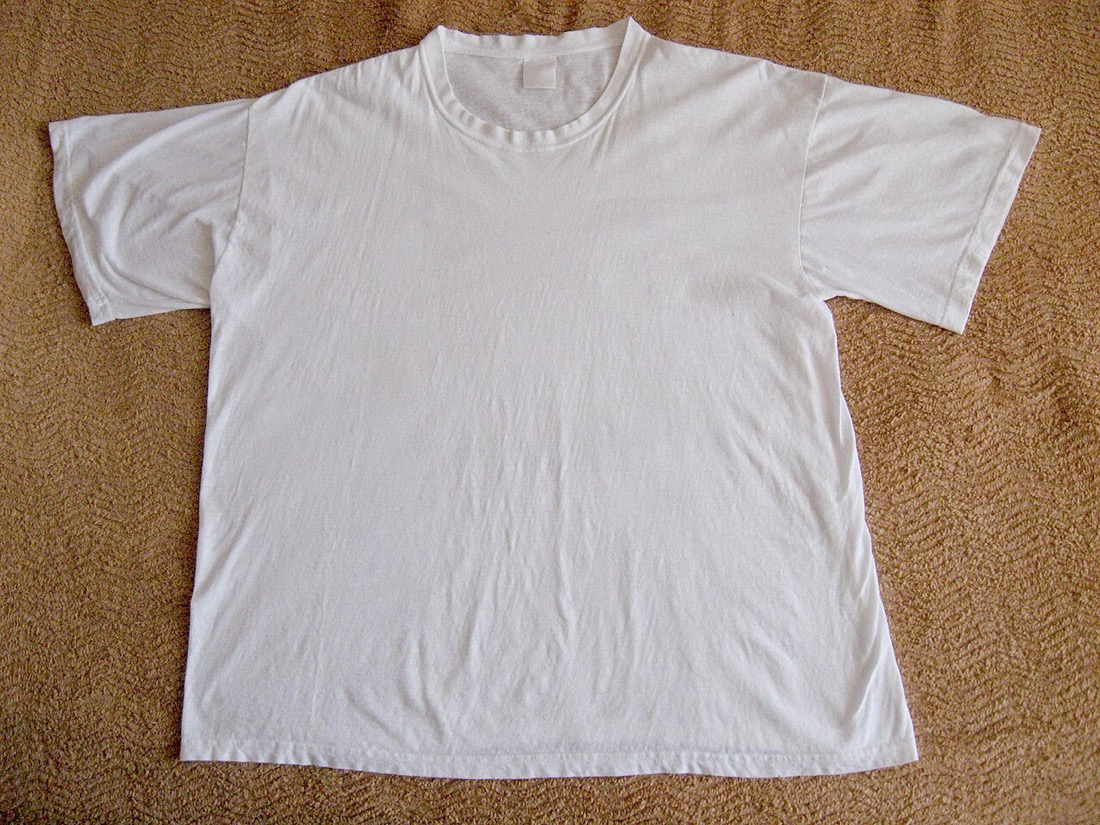
Photo: public domain, via Wikimedia Commons.

Prepare the reference garment
Lay the shirt on a flat, hard surface. Smooth it gently so seams sit naturally, but do not pull the fabric taut. Button or zip it only when the product type requires it. Use a tape measure or rigid ruler with centimetres or inches, and write down the unit before recording any numbers.
The aim is repeatability. If you measure the same shirt next month, the result should be close enough to explain a one- or two-centimetre difference. Avoid measuring while the garment is hanging, folded, or stretched over a chair; gravity and tension make the result difficult to compare with a retailer’s flat chart.
Measure the four points that matter
For most T-shirts, start with these points:
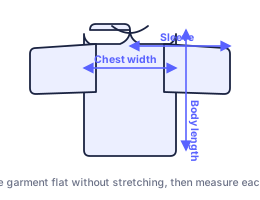
- Chest width: measure straight across from underarm seam to underarm seam. Multiply by two only if the new chart explicitly uses circumference.
- Body length: measure from the highest shoulder point near the collar to the hem.
- Shoulder width: measure seam to seam across the upper back.
- Sleeve length: follow the retailer’s definition; some measure from the shoulder seam, others from the centre back neck.
If the shirt has dropped shoulders, a curved hem, a boxy cut, or raglan sleeves, note that difference rather than forcing an inaccurate comparison. Those design features change the meaning of a basic width measurement.
Compare like with like
An online listing may say “chest 56 cm” but not state whether that is flat width or circumference. Look for a measurement diagram, product photography, or help note before assuming. If it says “pit to pit 56 cm,” it is normally a flat garment width. Compared with a successful shirt that measures 54 cm flat, the new shirt is about 2 cm wider across the front and about 4 cm larger around the chest when measured the same way.
That difference may be meaningful for a close fit and insignificant for an oversized tee. Use the cut to interpret it. A straight hem, heavier fabric, and dropped shoulders may make a small numerical difference feel larger in wear than it appears on paper.
Worked example
Your preferred cotton T-shirt measures 52 cm pit to pit, 70 cm in body length, and 46 cm shoulder to shoulder. A new listing in the same style reports 54 cm chest width, 71 cm length, and 47 cm shoulders for size M. The measurements suggest M will be modestly roomier without becoming a different silhouette. If size L jumps to 58 cm chest width and 74 cm length, that is not simply “one size bigger”; it may change the intended look.
Record the comparison in a short note: product type, reference measurements, new chart measurements, fabric, and intended fit. This gives you a clear reason for the choice and makes future purchases easier to compare.
For a deeper explanation of why body and garment numbers differ, see Body Measurements vs Garment Measurements. Merchants can use the same method in reverse when building an accurate size chart for product pages.
A comparison sheet that prevents repeat mistakes
Use a small note or spreadsheet with one row for the successful shirt and one row for the product you are considering. Keep the unit the same throughout. Include garment type, fabric, chest width, body length, shoulder width, sleeve method and intended fit. The purpose is not to create a perfect universal profile; it is to make one like-for-like comparison repeatable.
Here is a useful interpretation rule. If a new shirt is 1 cm wider flat at the chest than a favourite shirt, it is about 2 cm more generous around the garment when both sellers use the same flat method. That may be barely noticeable in a relaxed jersey tee and very noticeable in a fitted woven shirt. A difference in shoulder width changes how the sleeve begins; a difference in body length changes the silhouette even if the chest number is identical. Read those columns together.
When a listing does not define its method, do not manufacture precision. Check the brand’s help page, image diagram or support team. Save the listing URL and the version of its chart with your note. If the shirt arrives and the measurement differs materially from the published table, that record gives you useful evidence for a return or a future purchase decision.