Girth is the number that matters most
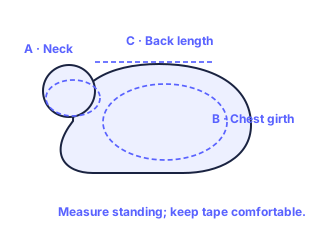
For almost every harness, the decisive measurement is chest girth: the distance around the widest part of the dog’s ribcage, just behind the front legs. A harness wraps around the chest and shoulders, so the girth determines whether the straps sit where they should and whether the dog can slip out.
Measure with a soft tape while the dog is standing square. Sitting or lying down changes the chest shape, and you will read short.
Keep the tape snug against the coat but not compressing it, so that two fingers can still slide beneath. Record the number in the unit the seller’s chart uses, because some publish in inches and others in centimetres. Take the neck circumference as well (around the point where a collar naturally sits, partway down the neck), since step-in harnesses and some styles loop over the neck and use it as a secondary size.
Why two dogs of the same weight wear different sizes
Weight is a poor predictor of harness size because it says nothing about where the bulk is carried. A barrel-chested breed such as a French Bulldog or an English Bulldog can share a weight with a lean breed like a Whippet while needing a much larger girth. Conversely, a long-coated dog measures larger through the coat than its body weight suggests. Treat the weight range on a chart as a rough check, never the deciding column.
Breed averages are the same kind of trap. Charts that list a breed next to a size are describing the typical adult of that breed, and individual dogs vary widely within a breed; a small male Golden Retriever and a large female can sit in different sizes. The only reliable inputs are the measurements of your dog, taken this month, because weight and muscle change over a dog’s life.
The two-finger check and what “snug” means on a moving dog
A correctly fitted harness is snug but never tight. The practical test is the two-finger rule: you should be able to slide two fingers flat between any strap and the dog’s body. More room than that and the dog may back out of the harness; less and the straps can restrict breathing and chest expansion during exercise. Watch the front of the harness too, the chest strap should sit clear of the throat and never press the windpipe when the dog pulls or sits.
Fit is judged on a walking, moving dog. After fastening, run your hand under every strap, ask the dog to sit and to lie down, and check that the front legs move freely without the strap edges digging into the armpits. A short walk reveals what the fitting cannot: straps that ride forward, rub, or loosen. Check again after the first walks, because straps settle and coats compress.
Puppies, coats, and other reasons to re-measure
A harness that fits today may not fit in three months, and the fastest change comes from growth. Puppies should be re-measured every few months, and a harness bought with room to grow should be adjusted at the buckles as the dog fills it, but not bought so large that the dog can slip a leg through a gap. Adult dogs change too: winter weight, a thicker seasonal coat, muscle from exercise, or a grooming all move the girth reading by enough to matter.
Thick coats deserve special attention. A harness sized over a full winter coat will be looser after the coat is clipped, and a harness that fits a clipped dog in summer may not close over a dense undercoat in winter. If the dog wears a coat or jumper under the harness in cold weather, measure with that layer on, and re-check the two-finger rule with it in place.
Collar sizes are not harness sizes
Do not choose a harness from the dog’s collar size. The collar measures the neck, while the harness is sized around the chest, and the two numbers can be wildly different on the same dog, a deep-chested dog with a slim neck may wear a small collar and a large harness. The reverse mistake is equally common with step-in styles, where a neck measurement that matches does not guarantee the girth will. Always take both measurements, but let the chart’s girth column make the decision.
When a dog falls between two printed sizes, choose the larger and use the adjustment straps, provided the harness can still be snugged to the two-finger standard. A slightly large harness can almost always be adjusted; a too-small one cannot be made safe.
A fitting routine before the first walk
- Measure chest girth and neck while the dog stands, and weigh the dog as a secondary check.
- Compare both measurements with the maker’s chart, prioritising girth over breed and weight.
- If between sizes, choose the larger and adjust the straps to the two-finger standard.
- Check that the chest strap clears the throat and the front legs move freely.
- Walk briefly, re-check the straps, and re-measure every few months for puppies or during coat changes.
Harness sizing conventions and adjustment ranges vary by brand, so confirm the maker’s chart for the exact harness before buying.