Measure the circumference, not the silhouette
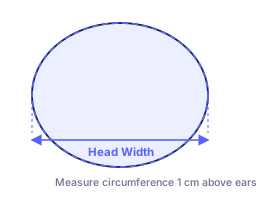
A fitted hat is sized from one horizontal measurement: the circumference of your head at the line where the hat’s inner band will sit. Place a soft tape around your head about a finger’s width above your eyebrows and ears, keep it level all the way around, and pull it snug without compressing your skin.
Take the reading two or three times and use the largest result. Hands tend to relax after the first pass, and a tape that drifts during measuring understates the size the hat will have to cover.
If you have no flexible tape, wrap a strip of paper or a piece of string around the same line, mark where it overlaps, and measure that length flat against a ruler. The number you get, in inches or centimetres, is the value the hat’s size chart will ask for. The silhouette of the hat (crown height, brim width, how it sits) does not change this measurement. A shallow porkpie and a deep cowboy crown in the same size both rest on the same band line; what differs is how much head they cover above it.
How the US numeric scale works
Fitted hats in the United States are labelled in eighth-inch steps, commonly from 6 7/8 up to 8, and the whole number is not an inch reading. It is a traditional hat-industry scale that sits just below the actual circumference: a size 7 hat is cut for a 22-inch head, not a 7-inch one. The familiar steps run 6 7/8 (about 21 5/8 inches, or 55 cm), 7 (22 inches, 56 cm), 7 1/8 (57 cm), 7 1/4 (22 3/4 inches, 58 cm), 7 3/8 (59 cm), 7 1/2 (23 1/2 inches, 60 cm), 7 5/8 (61 cm), 7 3/4 (62 cm), 7 7/8 (63 cm), and 8 (25 inches, 64 cm).
Brands do not always round these centimetre values the same way; some charts print 7 1/2 as 59.7 cm and 8 as 63.5 cm, so compare against the centimetre column published by the exact maker rather than converting the fraction yourself.
Two quirks matter when you shop across borders. British fitted sizing uses the same imperial scale but runs an eighth of an inch smaller, so a US 7 1/4 corresponds to a UK 7 1/8. And because each step is only an eighth of an inch (a little over 3 mm), a small difference in measuring technique can move you a full size. Measure carefully, and when your reading lands between two printed sizes, take the larger one: a slightly loose fitted hat can be snugged with sizing tape behind the band, while a tight one cannot be stretched reliably.
Metric sizes, S/M/L labels, and where they drift
European and many Asian brands label the hat by head circumference in centimetres, which removes the conversion step entirely. If your measurement is 58 cm, you look for a 58 in that brand’s chart. The catch is that centimetre-only charts round to their own increments; some step by one centimetre, others by two, so a 57.7 cm head may be directed to a 58 in one shop and a 59 in another. Letter sizing (S, M, L, XL) is used for flexible, adjustable, and casual styles rather than rigid fitted crowns. Typical ranges run about 54–56 cm for small, 56–58 for medium, 58–60 for large, and 60–62 for extra large, but each brand draws those borders differently, and a “one size fits most” snapback relies on its strap to cover the rest. Treat a letter as a suggestion that the strap or fabric can correct, and a numeric size as a decision the hat itself has already made.
Beanie stretch, structured crowns, and brim fit
Different constructions forgive sizing errors differently. A knit beanie or a ribbed cuff hat stretches over a range of heads and usually feels acceptable in one or even two adjacent sizes. A structured fitted cap (the type with a stiffened front panel) does not stretch at all, and a wool or felt dress hat yields only slightly after repeated wear. When the crown is rigid, the circumference reading has to be right the first time.
Watch the band, not just the crown. A hat that is a half-size too small announces itself as a red line across the forehead, a headache after an hour, or a brim that rides upward. A hat that is too large slides down over the ears or spins when you turn your head. Crown depth matters as well: two hats with the same circumference can differ in how deep they sit, and a shallow crown will perch on top of a deep head. If the maker publishes a crown-depth or shape note, read it against your own head shape before ordering.
Hair, seasons, and other variables that change your size
Your measurement is not a fixed number. Thick or long hair, especially hair worn up or tucked under a beanie, adds circumference, sometimes a quarter to a half size. A hat bought after a fresh haircut can fit differently once the hair grows back, and a summer cap sized on a cool morning can feel snug on a hot afternoon. The effect runs one way in practice: nearly every variable adds volume rather than removing it, which is another reason to round up when in doubt.
Adjustable hats cover these fluctuations with a strap or elastic; fitted hats need a plan. Hat sizing tape or a foam insert behind the sweatband takes up roughly half a size of slack and is removable if conditions change. Store structured hats with the crown supported so the band keeps its shape between wears, and re-measure once in a while rather than assuming the size is permanent.
Five checks to run before ordering a fitted hat
- Measure your head circumference at the band line, level, two or three times; use the largest reading.
- Record the number in both inches and centimetres so you can read either column.
- Identify whether the hat is fitted (numeric size), adjustable (letter or strap size), or knit (stretch range).
- If you fall between printed sizes in a fitted hat, choose the larger and plan on sizing tape.
- Account for how you will wear your hair under the hat, and recheck the maker’s crown-depth note.
Head measurements and size labels vary by brand and style, so confirm the seller’s chart for the exact hat before buying.